

Suppose you’re comparing two proposals to automate releases for the same product. The timelines and prices are substantially different, but both teams make a strong impression in the technical discussions.
Then you learn that the first estimate assumes environments and access are already in place. The second includes setting them up and getting approvals. In one proposal, the architect handles the initial design. In the other, the architect also reviews changes during implementation.
The price difference starts to make sense. But you wouldn’t have known why from reading the proposals.
Choosing a DevOps partner involves evaluating both the engineers and the company behind them. Can the engineers work effectively with your system? And will the company make the people and expertise you’re evaluating available to your project? A strong technical interview only answers part of that.
1. What does the estimate assume your team will handle?
A partner estimates the pipeline work and gives you a delivery date. The timeline may depend on work outside that scope: getting access, preparing a test environment, or making changes to shared infrastructure.
Meanwhile, the environment still needs to be built, access requires security approval, and the platform team is busy with its own release. The partner’s estimate may be reasonable for the work it expects to do. There’s just more work involved in getting to production than the proposal covers.
A recent release can help expose those assumptions. The change was ready on Tuesday but didn’t ship until Friday. What happened in between? Who was waiting for a response? Who changed the configuration? Who had to explain why another permission was needed? Which of those tasks will the partner handle?
That discussion also clarifies the engagement model. You may need an engineer whose work your tech lead prioritizes, with your team helping coordinate across departments. Or you may want a team to take responsibility for a defined scope of work and report back on results. Team augmentation and dedicated teams involve different working arrangements, but the label alone doesn’t tell you how a particular engagement will run.
Your team will need to be involved either way. The problem is unplanned involvement: the partner has started, you’re paying for its time, and the people it needs on your side aren’t available.
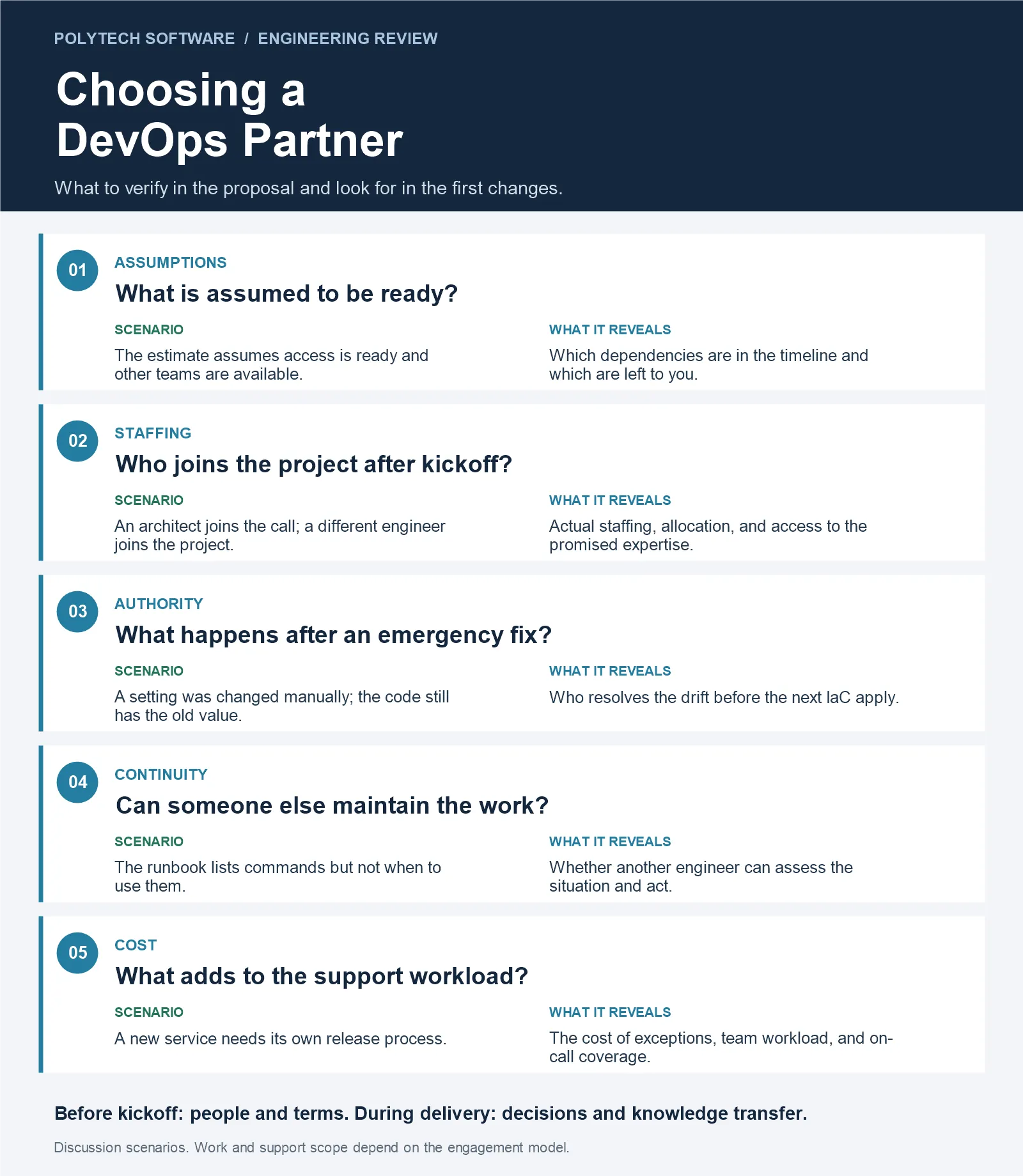
2. Who will actually be on the project?
During the technical call, an architect asks good questions, spots constraints, and proposes a sensible approach. A different engineer will do the implementation. That’s a normal division of responsibilities. What matters is whether the architect stays involved and what that involvement includes.
“We’ll bring in experts as needed” leaves a lot open. One partner includes regular design and code reviews. Another charges separately for consultations. A third can help when the right specialist becomes available from another project.
It’s worth understanding whose time is allocated to your engagement. Who works on it day to day? Who reviews difficult changes? Which roles are staffed, and which people still need to be hired or assigned?
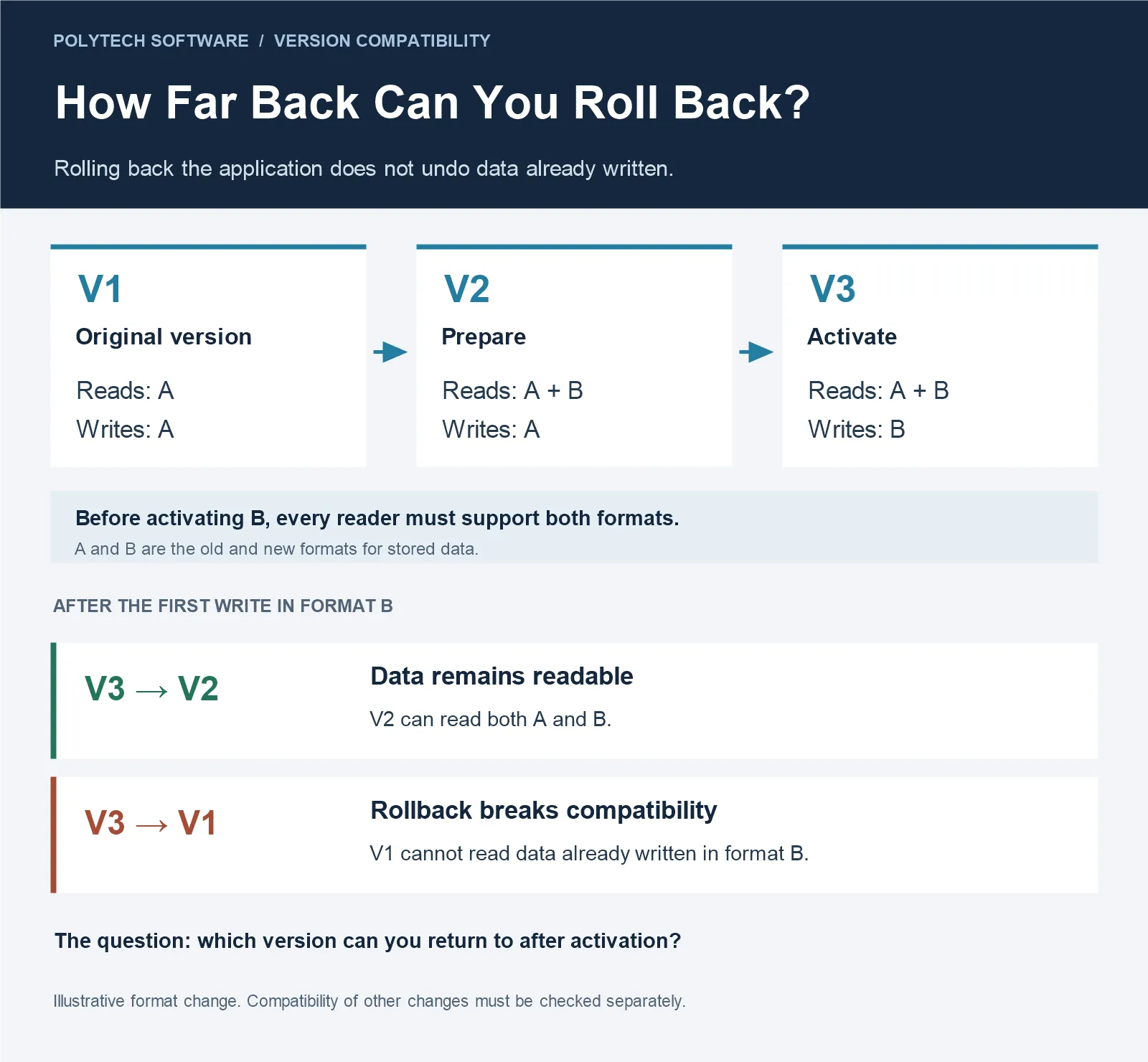
With the proposed engineer, a specific failure scenario can reveal how they think. Suppose a new service version has written data in a different format and errors start appearing. Does the engineer immediately suggest rolling back the application image? Or do they first ask whether the old version can read the data that’s already been written?
That’s a useful distinction: did they identify the constraint before choosing a recovery method? AWS’s discussion of rollback safety explains why reverting an application doesn’t necessarily restore a working system.
A discussion like that tells you more about an engineer’s technical judgment than another list of tools they’ve used.
There’s a separate question for the company: what happens if that engineer leaves the project? Who finds the replacement? Will there be an overlap period? Who explains the decisions the previous engineer made and why?
A similar résumé doesn’t replace that knowledge. Someone will have to carry the extra workload while the replacement gets up to speed. Whose time is built into the arrangement?
3. Who owns the follow-up after an incident?
An engineer changes a cloud resource setting manually and restores the service. The infrastructure code still contains the old value. The next apply could undo the emergency fix.
The incident is closed, but the work isn’t finished. Someone needs to decide whether the new value should stay, update the code, and make sure the next automation run won’t bring the problem back.
This is where ownership can get blurry. The on-call engineer restored service. The application team considers the issue resolved. The infrastructure engineer may not have been involved at all. Who owns the follow-up?
The pipeline is in place, but some releases still happen manually. One engineer keeps deploying from a laptop because that’s how they’ve always done it. Another bypasses the pipeline because it’s missing a step or a flaky check keeps blocking the release. Both release processes are still in use.
Missing functionality or a flaky check gives the partner something concrete to fix. Continued bypasses out of habit are harder to address from outside the team, especially if the partner has no say in how releases are run. That’s a conversation with the client’s technical lead. A manual deployment may still be the right call during an incident. But if it becomes routine, it gets harder to tell what shipped and which checks actually ran.
Access can be just as misleading. An engineer may have no direct access to production but still be able to edit a workflow that uses production credentials. A list of individual permissions won’t necessarily show everything that person can affect.
The relevant questions are specific: who reviews workflow changes, when secrets become available, and where untrusted code runs. GitHub’s guidance on securing workflows covers these relationships.
Security scanning creates a similar ownership question. A scanner finds a vulnerability. Who investigates it? Who fixes it? What happens when an approved exception expires?
An engineer joining your team will work within your existing processes. A partner taking on a defined support scope may have different responsibilities. “DevOps” alone doesn’t establish an on-call schedule or a commitment to handle every incident affecting the product.
4. Who will run and maintain the system after handoff?
The handoff looks complete: the client has the documentation and admin access. But when maintenance comes up, nobody is clearly responsible for deciding what takes priority, who will do the work, or when it will happen. That responsibility was never assigned on the client side during the project.
This can go unnoticed while the external engineer keeps handling the work. Once they step away, tasks sit unassigned because no one on the client side has been given the time and authority to take them on.
Even when someone does take on the work, they may be dealing with a system they didn’t help build.
The runbook includes a restart command. It doesn’t explain when restarting will help and when it might hide the symptoms. The architecture document describes the design but leaves out why the team rejected a simpler approach.
Until now, the original engineer has been answering those questions in chat. Without them, every departure from the documented procedure sends someone back into the system to investigate.
Walking another engineer through an unexpected scenario shows how much knowledge has actually transferred. Where do they pause? What information do they need? Can they tell when the documented procedure doesn’t apply?
There’s a meaningful difference between instructions someone can follow and information that helps them decide what to do.
That doesn’t require documenting every detail. Often, the missing pieces are specific: who owns a dependent service, which exceptions already exist, or why an unusual setting was left in place. One example of organizing that knowledge for a distributed team is shared playbooks and a service catalog that records ownership and dependencies.
Evaluating results takes similar care. Deployment frequency rises after a pipeline change. The team may be shipping smaller, independent changes. It may also be deploying more urgent fixes. DORA’s deployment rework rate measures the share of unplanned deployments made in response to production incidents. DORA’s metric definitions and guidance explain how to interpret those measures.
Early on, it’s easier to assess changes directly tied to the engineer’s work: less time waiting for a runner, fewer reruns caused by a particular flaky test, or an environment that no longer needs manual adjustments. Those are useful results. Establishing their effect on the speed and stability of the full delivery process takes more observation.
5. What will ongoing support actually cost?
Ten similar services can require less attention than one product with separate customer environments, different release windows, and several deployment methods.
Service count tells you little about the workload on its own. The next service you plan to add is a better test. Can it use the existing template? Or does it need a separate process, its own checks and permissions, and different recovery procedures? Who maintains those exceptions?
A shared pipeline template also needs work after its first successful run. Dependencies change. Compatibility needs to be checked. Updates need to reach the projects that use it.
If none of that is in anyone’s backlog, you get a familiar problem: everyone uses the template, but nobody owns its maintenance. Each product team is focused on its next release, and no one has planned the work to migrate everyone else.
Interruptions affect the cost, too. An engineer plans improvements but spends part of the week responding to incidents. If that keeps happening, there’s less time for the work you brought them in to do. Expanding support changes both the price and the capacity available for planned improvements.
Two proposals with the same monthly price can therefore cover very different commitments. One includes planned work during agreed hours. Another also includes on-call coverage, access to additional specialists, and time for incident follow-up. You can only compare them meaningfully once those assumptions are clear.
Before the engagement starts, you can clarify staffing, terms, and what the partner needs from your team. You’ll learn how the engineers work with your particular system once they start making changes.
A small, real task is more revealing than an isolated demo: a pipeline change that has to work with your existing permissions, checks, and dependencies. The scope is limited, but the engineer is dealing with conditions they’ll encounter throughout the project.
A technical discussion lets you assess experience and reasoning. The first changes you make together show how that reasoning holds up: which constraints the engineer catches, what they clarify before touching the system, and whether their teammates can understand and maintain the result. That’s how you learn what you can confidently hand over next.
#DevOps #DevOpsPartner #SoftwareDevelopment #ITOutsourcing #EngineeringLeadership