

A long-term development partner builds up knowledge that saves its clients money. Unless that knowledge can be passed on, it also caps how fast they can grow.
Every long engagement produces an asset that never shows up on an invoice. A few years in, a good engineering partner can save a client money before anyone writes a line of code. Someone remembers why a similar change was shelved. Someone spots a problem for customers on legacy contract terms. Someone asks the question that changes the scope.
Proposals list roles, rates, and timelines. What clients actually get over time is a team that remembers why the product works the way it does, including details everyone else has forgotten.
That memory is valuable. It is also a constraint, and most companies only notice it when they try to grow.
When Adding People Stops Adding Capacity
As long as the original team keeps delivering, nobody asks where the product knowledge lives. The question comes up when the company launches a new business line, hires its own engineers, or brings in a second vendor. Hiring turns out to be the easy part. Getting new people productive is harder.
The code is accessible. The documentation exists. But almost every significant change still needs a conversation with the original developers, because the critical knowledge sits in people's heads, not in the system.
A Stuck Screen, Two Different Problems
Here is how ordinary that knowledge can look. A customer sends money through a financial app. The confirmation never arrives, and the screen stays on "Processing." Support tickets pile up. Someone suggests the obvious fix: after a minute, show an error and let the customer try again.
The suggestion is reasonable, and it is risky. A missing response doesn't mean the transfer failed. The money may have moved while the confirmation got lost. If tapping the button again starts a new transfer, the customer pays twice.
The customer sees a frozen screen. The engineers need to work out what happened to the money and what the system can safely do next.
The safeguard is called idempotency: retrying the same request must not create a second transfer. A common approach is to reuse an idempotency key for every retry of the same operation, as Stripe's documentation on idempotent requests explains. The key protects the customer only if the service processing the payment recognizes and enforces it. Storing it in the app is not enough. And the team still needs a reliable way to establish the transfer's final status.
Experienced engineers know where to check the transaction, when a retry is safe, and what to do when a confirmation arrives late. The app can show a better waiting state without treating a timeout as proof of failure. This is exactly the knowledge businesses pay senior engineers for. Whether anyone else can build on it is a separate question.
From Memory to Mechanism
Knowledge becomes transferable in three layers, and each one does a different job:
- An instruction tells people what to do. A code comment saying "Reuse the original idempotency key" is useful, but it doesn't explain why.
- A decision record explains why. A short architecture decision record (ADR) captures the failure scenarios the team considered, the alternatives it rejected, and the trade-offs it accepted. Microsoft's guidance on ADRs makes the point that preserved reasoning lets teams judge whether a decision still holds as circumstances change.
- A test makes sure the rule is followed. An automated test that simulates a lost confirmation followed by a retry, and checks that no second transfer is created, catches a violation before it reaches customers.
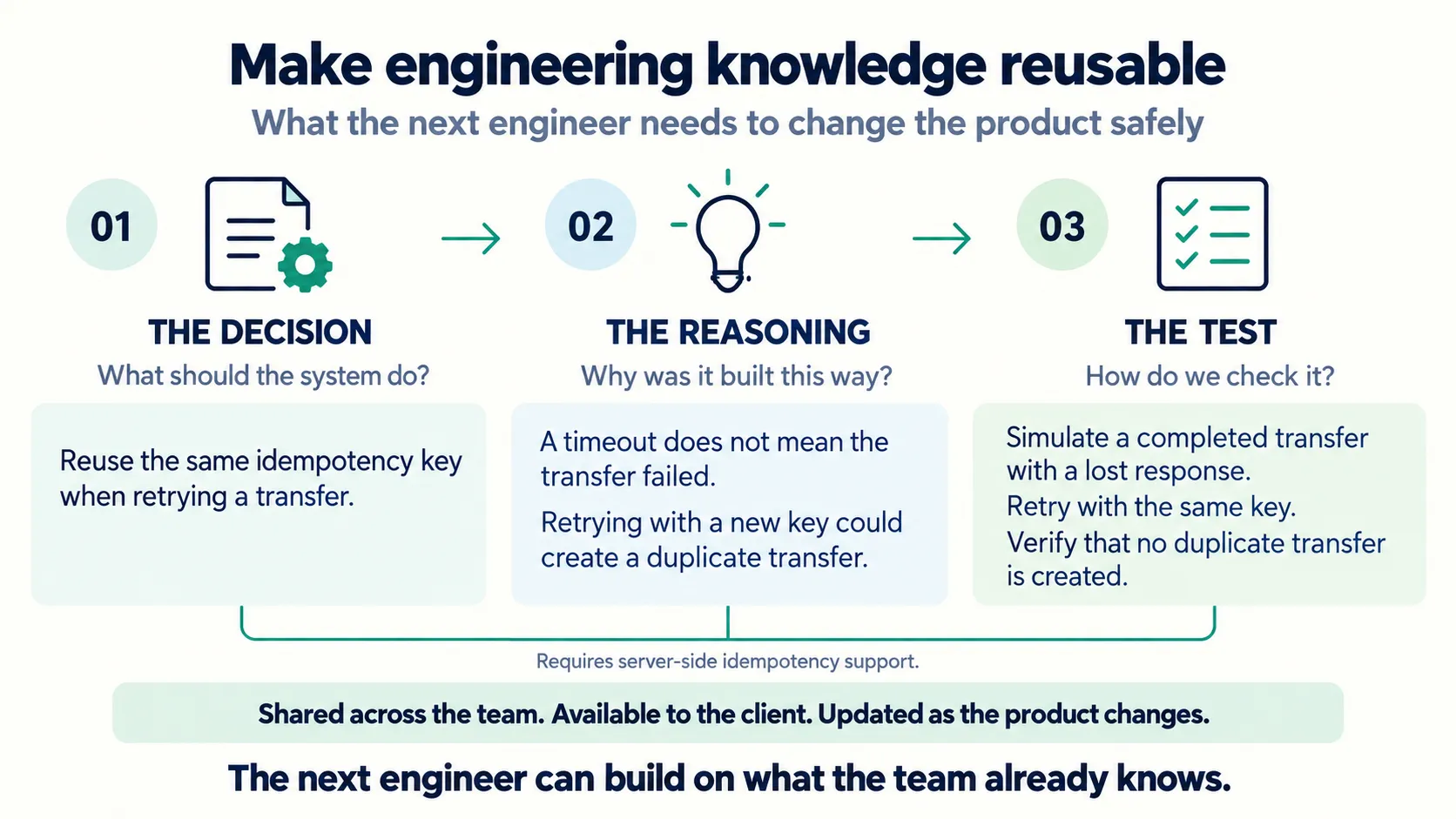
Together, these layers make the original team's experience available to people who weren't in the room. New engineers get up to speed faster, and senior engineers spend less time re-arguing settled questions.
What It Looks Like at Scale
Polytech's work on a cloud platform for marketing materials shows why this matters in larger systems. The engagement began in 2009, and the product's engineering organization now spans 12 countries. Businesses use the platform to store and edit marketing assets and to arrange printing and delivery. A single change can affect payments, file processing, and what comes off the printing press.
Polytech built shared playbooks for engineers and product managers, plus a service catalog that maps services, owners, and dependencies. In its case study on the long-term QA partnership, Polytech reports more predictable releases and smoother onboarding. None of this shows up in a product demo. It shows up when distributed teams ship changes knowing what those changes affect beyond their own code.
Smaller products need less. A few records of key decisions, a clear release process, and tests for critical failure scenarios usually beat a sprawling portal of outdated pages. The right investment depends on how complex the system is and how expensive a wrong change would be.
Why Both Sides Put It Off
Partners have as much at stake as clients. If only one engineer can run a complicated release, that person's vacation becomes a negotiation. If only the team lead can explain the system, every new hire adds to the lead's workload.
Still, the work keeps getting postponed, for a simple reason. On a familiar task, an experienced developer is faster alone than while walking a colleague through it. Anything that doesn't move the next release forward looks optional. But there is always another release, and eventually the deferred work becomes the limit on how much the team can deliver.
The Client's Side of the Bargain
Clients don't need a second engineering organization duplicating the partner's work. They need someone with the expertise and the time to translate engineering proposals into costs, schedules, and business commitments.
Deloitte's April 2026 analysis of outsourcing and internal capabilities looks at how organizations can combine the two. Applied to product development, the roles are clear: the partner brings specialized expertise and extra engineering capacity, and the client keeps the ability to set direction and evaluate the work.
The Bottom Line
Some knowledge will always come only from working on the system firsthand, and the people who have it will stay valuable. A strong partnership spreads that experience across the team, so each phase of development builds on the last instead of starting over.
That is the economic case for a lasting relationship with a capable engineering partner. An hourly rate tells you what an engineer's time costs today. The quality of the team determines how many times you'll pay to solve the same problem.
#EngineeringIndex #SoftwareEngineering #EngineeringLeadership #CTO #DedicatedTeams #KnowledgeTransfer #SoftwareArchitecture #ProductDevelopment #EngineeringManagement #SoftwareOutsourcing #TechnicalLeadership #DistributedTeams #SoftwareQuality #EngineeringProductivity #TechnologyPartnerships